Every great creator senses when the work [they] create
sis under the threat of extinction. The cliff was always two steps away, dark and foreboding by day and night.— Ismail Kadare, Aeschylus, the Lost.
I always admired the power of music and cinema to transform our sense of reality, how music can incite a riot or a reconciliation, or appear so threatening to an authoritarian regime, to the point of provoking the persecution, torturing and killing of musicians. Cinema is not different, and I distinctly remember the feeling of embodied reactions associated with the encounter with a “good” film, as they integrate to our consciousness before we can make linguistic sense of our experience. I’m not referring to the value judgment we make by means of a rational, disciplinary critique; rather, I’m speaking of the ability of arousing our thinking-feeling apparatus with a mastery that is almost inaccessible to other expressions.
Power has always understood this capacity; cinema was a favored weapon for Cold War propagandists, just as music was a stringent enemy of South American military dictatorships. Today, their washed out descendants—the bite-size, revenue-driven audiovisual trimmings of social media—still broker the feelings of multitudes. I suspect that our attraction to certain artistic expressions has something to do with how they always seem to point elsewhere, to a different part of our feelings, our memories, and our psyche: “We don’t read and write poetry because it’s cute. We read and write poetry because we are members of the human race,” says a persisting vignette of John Keating, that fictional character from the late 1980s American cinema. And poetry is never only about language; it is also about sound. Punk music might not entirely be about music, and perhaps it is a bit more about politics, but no less than cumbia or dabke, which are also about somatic release, an experience not far from the pleasure of a good meal, which is mostly about smell. And again, sharing a meal is also politics.
This is a controversial thought to share among fellow artists, because it might suggest that visual art could be limiting or secondary, and my point is not precisely that. It is rather about the need to understand human expression and agency in an interconnected way, to mobilize our humanity beyond our current struggles and the prototypical responses we often produce. In another text, I argue that much of contemporary art has chosen to “congeal” itself for the sake of the market: it embraces the form of historic genres, while “wearing” pressing topics and reactionary attitudes—even ideologies—like interchangeable phone cases, always following trend but rarely with true consequence. However, it would be a mistake to stop at diagnosing the chronic wilting of an artistic discipline and not make a broader point about the vast power of our creative agency, which emerges when we move beyond the canon and the trend.
This text is an effort to articulate a specific embodied practice to sequences of personal vignettes, but also to thought processes that connect the human need of self-nurturing with questions about the notions of surplus and expenditure, expanded thoughts on fermentation, collaboration as a life politics, Sumak kawsay (or “good living”), and the dangers of weaponizing language and aestheticizing destruction. It pushes some of the seminal ideas from Part I into broader realms and moves towards the encounter with otherwise unsuspected thoughts that may arise from the practice of writing.
Sometimes Chicago is too cold for snow; depending on the temperature, this can mean two things: either the slush—an unfortunate assembly of soft snow, dirt, garbage and pollution—won’t invade the streets, easing the experience of winter; or it can signal the opposite: that the low temperatures threaten life to an extent it is no longer possible to exist outside your home. Such are the shifting moods of a Chicago winter, amplified by the powerful Atlantic winds that drop ten degrees Celsius as they sweep across the colossal Great Lakes. The weather is usually so severe that it takes over any conversation; students from tropical latitudes spend hours under a special “sun lamp” to mitigate the effects of Seasonal Affective Disorder (whose tragic, official acronym is SAD), and train stations are equipped with heating lamps that are essential for survival in the brutal weather, but which also make the groups of waiting commuters look stuck inside chicken incubators.
In my first Chicago winter in 2013, I heard that the low-pressure, cold-air area that forms around the North Pole had decided to move to our part of the world, and that we were possibly experiencing lower temperatures than most subarctic latitudes. I do, however, miss the intense feeling of grappling with life that was provoked by extreme cold, because it felt cleansing, and even focusing, like a permanent reminder of being alive. When I moved to California years later, the dry heat of the desert weather in the eastern half of LA didn’t have the same effect: I couldn’t think properly, and most of my energy went into keeping my cat alive and myself hydrated.
On a not-so-cold December day in northern Chicago, I invited a few people for dinner and drinks at the new house. I had recently moved in with my friend Tobias, hoping to save money and focus on studying and writing my graduate thesis. As our guests were leaving, the low pressure lifted, and it started snowing again after a long month of extreme cold. It would not stop snowing for another twenty-seven hours, and halfway through we realized we were trapped inside for a while. Tobi was an accomplished baker; I learned from him that Danish high schools offer vocational training as part of a comprehensive education plan, which includes truly valuable life skills, like carpentry, accounting, driving, and baking. My cooking ability instead consisted of years of silent observation in the family kitchen, of early experiments with soggy pasta, and the hardest gummy candies a 7-year-old can make. Later, I followed instructions from my grandmother’s old cookbooks, which accumulated an unpleasant amalgam of grease and dust on the top shelves of the kitchen; and then I metabolized a fraction of my other grandmother’s prodigious talent for cooking, as her helper and observer. Out of boredom, I traded Tobi rudimentary baking lessons for what we vaguely called Latin American cuisine recipes, which in Chicago really meant learning how to use essential Mexican ingredients and how to make arepas. We started with sourdough and apocryphal birria recipes, and cooked and baked our way through the long Midwestern winter.
For me, baking was a rather spiritual discovery, because like art, it felt like a world-making practice. It offered the possibility of creating a tiny fragment of our reality, a proof of my ability to contribute something meaningful to humanity. However, I would hesitate to share my skill for a number of years, waiting to arrive at a future state of “effortless action” (what Dao calls wu wei, an internalized form of action that becomes a natural flow), when my bread quality would always be consistent. Baking bread also became a space for active meditation, where I practiced presence and integration. Its physicality was an extraordinary anchor in the now, countering the gravitational pull of literature reviews, thesis concepts, financial concerns, conference deadlines, and part-time job applications. Together with running, baking rekindled my connection between my intellectual practice and my body, a quality of experience I had missed since I stopped my performance and street intervention work in the early 2010s. Kneading also made me reflect on labor; I originally thought of bread-making in the terms of Bataille’s notion of “unproductive expenditure,” mostly because it felt that there was an abyss between the reasonable price of a loaf of bread and the labor involved in making it. This disparity made baking seem like a form of intensive and indulgent craft, one which I would only share with family and my closest friends.
My initial thoughts on unproductive expenditure (dépense) have also been a source of hesitation. Because Bataille roots this notion in the idea of excess, it places all sorts of “surplus” activities in the same unstructured territory and allows the concept to be permeated by creative and destructive agencies equally. This conflation can be interpreted as a false sense of “natural” or “objective” order, and become instrumental in justifying non-equivalent actions, like purely aesthetic endeavors, religious sacrifice, and warfare—and often mixing the three. As supposedly inherent to the human condition, Bataille’s dépense ultimately sanctions the expenditure, accumulation, waste, and destruction of “surplus” resources by the wealthier classes, as long as the appropriate array of aesthetics, rituals, and social hierarchy is set into place.
Such justifications explain why our society is obsessed with the lavish lifestyles of the rich and famous (living them vicariously through our phone screens while sponsoring them in the process); why a smaller part of society justifies exploitation and plunder of the middle class (reinforcing social and racial hierarchies and legitimizing massive wealth transfers that would be called robbery if they flowed in the opposite direction); and why an even smaller fraction defends a right to war and extermination of an other (a weaponized secularization of sacrifice), provided that that appropriate language and aesthetics sanctifies the act.
There are, of course, lavish cooking and baking practices that fulfill Bataille’s case for self-destructive indulgence; bread, however—the one made simply with flour, water, and salt—belongs to a very different ethos. Its simplicity, accessibility of ingredients, and versatility place bread-making within a space of commonality that transcends historic periods and social hierarchies. The politics of bread are inscribed in its ingredients, process, and sharing; this was increasingly evident to me as I joined solidarity initiatives in the last two years: the intense labor of baking contrasted with the low cost of the ingredients, requiring more care and patience than a sophisticated execution. Bread became a multiplier of my agency, but also a conduit for deep connection with new communities, both physically and at a distance.
Even as an over-signified cultural symbol, bread is an artifact of solidarity and connection. In Zhanna Kadyrova’s Daily Bread (both from 2014 and 2022, coinciding with major events in the Russian-Ukrainian war), the artist created “bread loaves” out of river stones, merging an anachronistic signifier of artistic value (the stone as the solid and primordial material of sculpture) with the timeless symbolism of bread. The proceeds resulting from selling the works went to support the artist’s community back in Kyiv, enduring the consequences of a prolonged war. Meanwhile, in a devastated Gaza, bread-making has become a conduit of survival, as communities improvise mixes of scarce flour, legumes and pasta scraps, while others build makeshift clay ovens on site to make bread and keep one another alive.
I began to see bread, bread-making, and sharing more closely related to the contemporary Andean-Amazonian notion of Sumak kawsay (or “good living”). This Quechua neologism, rooted in various traditions throughout Abya Yala (among Aymara communities in Bolivia, Mapuches in Chile, and Zapatistas in Mexico, and many others), has been translated into policy frameworks in Bolivia, Ecuador, and Colombia over the past two decades. It refers to the cultivation of a “splendid existence”, achieved through a deliberate practice of doing things fully, with interconnectedness, balance, and harmony. The Quechua intellectual Javier Lajo notes that, because it is grounded in foundational life principles, Sumak kawsay necessarily entails health, relationality, and reciprocity, as a kind of immanent harmony. Unlike dépense, good living is not a deterministic trait of the human condition but an ethics of the self and/with the collective, an ontological imperative which exposes the distance between ideological militancy and the ethics of existence. When I moved to California, baking became both my company and sustenance during the first few weeks on a new job. Over time, it evolved into an associative agent, as my emotional and professional connections thrived in the new environment. And in the times when I visited Colombia, baking bagels became a way to nurture a relationship with my nephew, in the brief moments I could see him growing up.
Since I began my life in Mexico, I’ve had the opportunity to cook and bake in different professional contexts, gaining not only experience but also the generous guidance of remarkable local food practitioners. Over time, I’ve come to see that the conceptual horizon linking dépense and Sumak kawsay is essential for resisting the unbridled impulse of expenditure and for preserving the nobility of baking, cooking, and sharing from disconnected and pragmatic renditions. Good living, by contrast, is an ethical pursuit I constantly strive to embody; as a racialized person from the Global South, I tend to approach both notions as a kind of “foreigner”: breaking away from the rules of a guest house to embrace the hospitality and shelter of another. When I move to a new place, I like to start a new sourdough or ask a friend for some of theirs, and feed it at home. I’m drawn to the effervescence of the rising batter, and to the way water, flour, and wild yeast—naturally present in soil, air, and plants—generate infinite life without any processed ingredients. The vitality of the sourdough is entirely dependent on the health of its environment, but also on proper care and feeding, a practice that, in fact, becomes a gesture of mutual nurturing. Each new starter becomes a liaison between me and a new place, carrying the distinct life of its surroundings into the fermentation process and later into the bread. And the more I feed it, the more it becomes the place. In a similar way, the more we inhabit a life practice (such as good living), the greater its presence in our overall experience, and the less foreign we become to its virtues.
In Daniel Spoerri’s Anecdoted Topography of Chance, bread is the only contingent “object” whose remnants generate new life (as well as its own entry in the book): the crumbs, together with the leftovers of a previous meal, can become a festive Sunday banquet. This is the constant gift of bread: nothing goes to waste if that’s our desire. Such potential also manifests in the bread-making process: the time devoted to kneading, proofing and baking is an offering with no philosophical aspiration to be “pure,” in Derrida’s terms; rather, it just demands to be generous and abundant. Yet however we measure time for baking, wild yeast and the conditions of our domestic environments will ultimately dictate how much time you give to bread. Perhaps this had something to do with the source of my recent hesitation about returning to bread-making: at some point, and without realizing it, I pledged an infinite, selfless offer of time for baking and giving away, both of my labor and time. In the terms of Sumak kawsay, this equals an imbalance of life, because it’s ultimately a quiet immolation, one which attracts plunder. As a result, great loss and damage slipped in; and, to glance back at Derrida, the spoils of ungiven gifts circulate as counterfeit money.
Colonial histories are plagued with ethical-epistemic clashes between truce and deceit, sharing and looting, self-sacrifice and self-service, alliances for survival and conspiracies for destruction. These same histories are also infused with that drive for the aesthetics that Bataille defiantly upholds as an inevitability of expenditure, and that Ismail Kadare brilliantly unpacks in his 1985 essay on the Greek playwright Aeschylus. For Kadare, the invention of tragedy as a dramatic genre has something to do with the looming guilt of Greek society over their gruesome violence and abuse of Trojans. Tragedy became a psycho-social artifact for the dismantling of guilt and the fabrication of emotional closure, demanded by no one but the Greeks themselves. Its side effect, however, was diverting the Western gaze upon Greece away from the ethic and primordially into the aesthetic. This history naturally leads to Aristotle’s catharsis, and becomes a form of psychological release without reparation.
These ideas permeated my reflections on my own experience with unconstrained offerings and their consequences, prompting me to reconsider the dynamics of my personal history. Many of Aeschylus’ plays were lost, and Kadare mentions that the Greek author might have intuited this, or at least understood the volatility inherent to his practice. Unlike cinema or music, classic tragic theater didn’t intend to elicit an open psycho-somatic response; on the contrary, it was meant to perform a different kind of displacement: one that brings closure to the audience via sacrifice, through the loss and suffering embodied by the characters of the play. Today, the everyday use of the term tragedy implies a kind of inevitability with no liable parts, but the characters in a Greek play were fully inscribed in the unraveling of loss, death, or betrayal, either as victims, witnesses, accomplices, or perpetrators. To unravel calamity through different means inevitably produces discomfort in the audience, a reaction that, as Kadare notes, Aeschylus himself might have carefully avoided. And in our comfort-driven societies, provoking discomfort is severely punished. I’ve come to think that the greatest catastrophe is not the loss of the works themselves, as both skill and thought remain embodied in the author as seeds for future knowledge; rather, the deterritorialization of the practice, its disconnection from community, and our collective aversion to discomfort as a pathway toward reparation.
During the periods when I didn’t bake, I carried a persistent desire to return to it, seeing it as a mechanism to awaken my somatic awareness and as a space for sharing, though for some time it remained only a hesitation. Later, it became more than an embodied feeling: a therapist asked me not to come back until I had re-engaged with creating something material, not just writing. Then, a conversation with Kathryn, an artist and dancer I had briefly mentored, reminded me of the possibilities offered by bodily practices for healing and reconstituting the self. But it was only through a call to action, a solidarity initiative that prompted me to actively come back to baking. My contribution had to do with my bread-making abilities, and involved collaborating with colleagues and new friends in preparing large quantities of food for fundraising purposes. The humble status of the hand-shaped flatbread, its ubiquity and versatility, reminded me that bread-making is not an individual practice but a relational one. The action of baking, prompted by the urgency of a humanitarian crisis overwhelmed my initial hesitation.
Although that experience was meaningful in shaping many of the ideas I present here, my memories and feelings toward it exceed the intentions of this essay. But one essential insight it offered was the possibility of connecting on site and at a distance, in a way that overflows the limits of the screen (a primordial communication metaphor of our scopic-first contemporary world). It was the somatic and dialogic experience of creating food together with new people who later became friends and listening to their family histories, and attuning to the subtle nuances of culture, smell, flavor, and humor that reminded me of the power, nature, and possibilities of bread-making. The practice of baking in this context becomes a warp in which multicultural threads are inscribed for creating a generative structure of cultural intersubjectivity (what Rivera Cusicanqui’s describes as tejido, or weave), with a lasting presence in our experience, as another way of becoming less foreign. In this way, baking and sharing become a powerful and coherent means for embodying politics.
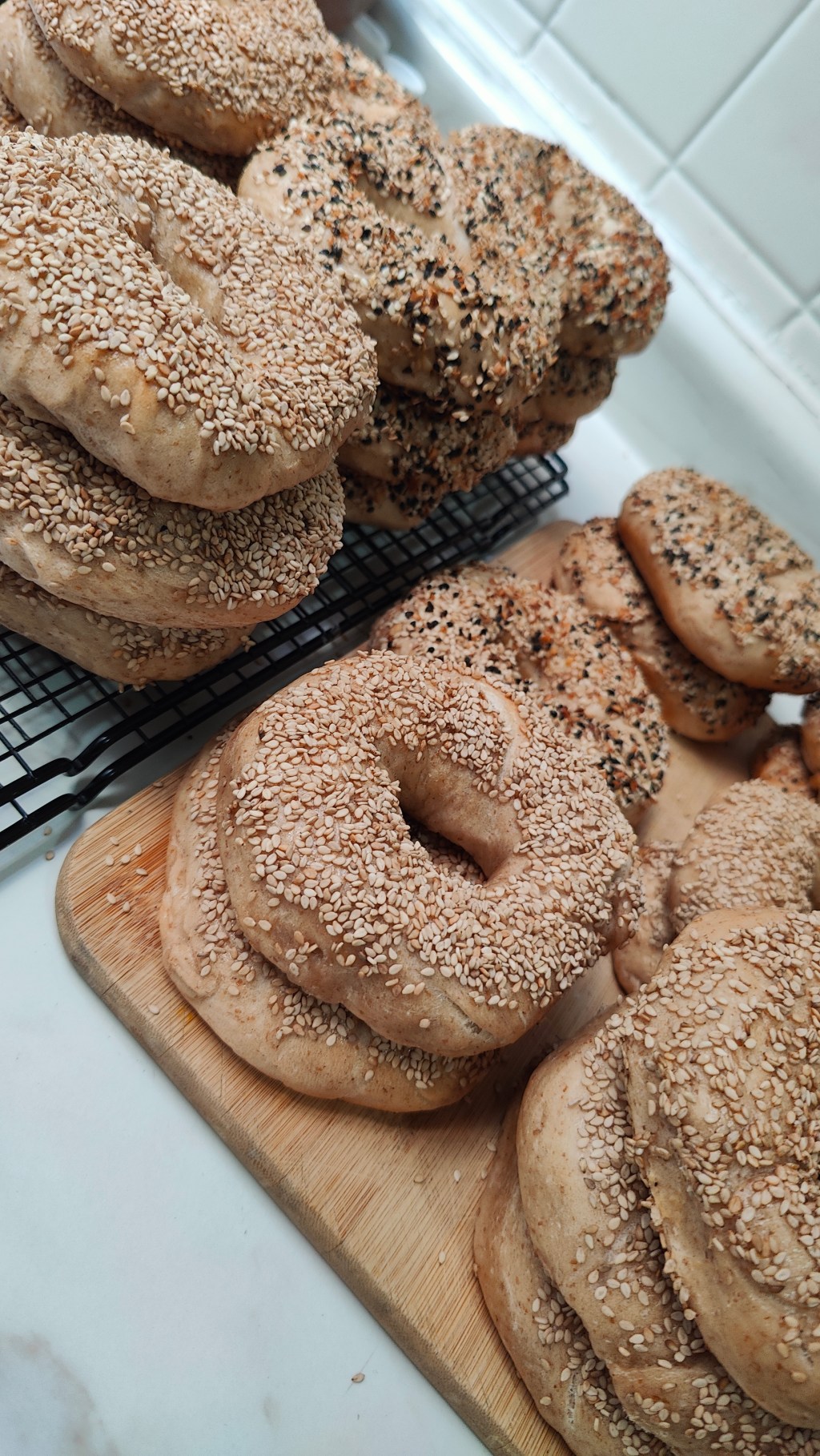
Halfway through writing this text, I decided to start making homemade bagels to earn some extra income, and as a way to rekindle connections with friends and colleagues from the food industry. It happened after more than a year of hesitation, for reasons that go beyond any certainties about my skill. Since I am speaking of an embodied thought, it made sense to practice it and let it mobilize words, much like performance once did in shaping the impetuous tone of my early writings on art and politics in the late 2000s. This also led me to a realization: if I look back at the moments when bread-making has been most meaningful to me, they have always taken the form of encounters. First, the lessons from Tobias and the breakfast invitations to our neighbors in the cold winter; then, the introspective practice that accompanied my moves across the United States; later, the reconnection with family through baking as a hub for our disparate singularities; and, finally, the friendship of those who taught me how to approach our shared humanity through the smell, look, touch, and taste of taboon bread. As Alia al-Saji writes, “[t]he past is not the accumulation of events in a container, but the continuous immanent transformation of sense and force that is tendency.” In this light, hesitation is not merely a withholding of action or a postponement, but a form of becoming that integrates the sequences of connections, skills, and memories that constitute an embodied cultural practice.
Bread-making led me to think about the displacements I mentioned at the beginning of this text, which I consider essential to the vitality of artistic practice today. The generative wholeness of sourdough and the poetic possibilities of fermentation began as a rhetorical object but eventually enabled me to think about the politics of a lived practice, while allowing me to loosen the tensions I had between my thoughts and experiences of late. To give a closure to this reflection, it seems appropriate to finish, unorthodoxly, with a quote that emphasizes many of the ideas that came out of the thought trajectory represented in this essay. In her Fervent Manifesto, Mercedes Villalba writes: “What are the politics of fermentation? They allow bodily and cognitive redistributions of power. (…) listen to the voices that challenge the limits of your body. Make them kin.” And it is that making of kin, of the voices included in the previous thoughts and the thoughts themselves, what I’m striving for as I write these lines.
[End of Part II]
—David Ayala-Alfonso
Mexico City, October 2025.
.
.
.
.
.
.
Sequences of Hesitation, Part II © 2025 by David Ayala-Alfonso is licensed under Creative Commons Attribution-ShareAlike 4.0 International


.
.
.
.
.
.

 a copy is a copy is a copy